
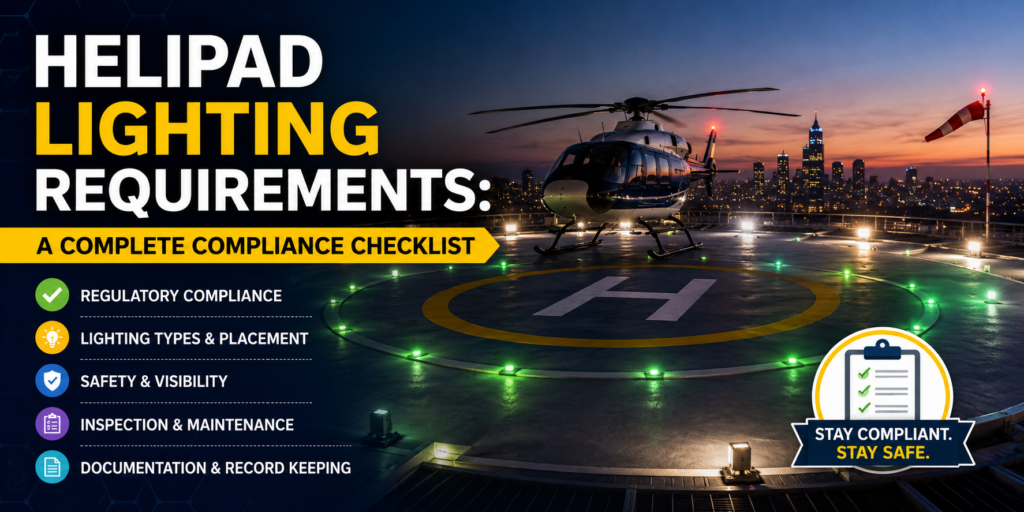
Understanding helipad lighting requirements starts with one simple problem: a helicopter pilot approaching after dark, or in poor visibility, needs to see the landing area, understand its boundaries, judge the wind, and identify any nearby hazards — all from the air, all before touchdown. ICAO, CAP 437 and the FAA each set their own helipad lighting requirements, but they are scattered across several standards and several types of equipment.
This is a working checklist — a single reference pulling those requirements together by equipment type, with links through to our deeper guides on each item. If you manage compliance for a helipad, heliport or offshore helideck, use this as the starting point, then follow the links for the standard that applies to your site.
Who Sets Helipad Lighting Requirements?
- ICAO Annex 14 sets the international baseline helipad lighting requirements for aerodromes and heliports, including wind indicators, that applies broadly across most jurisdictions.
- CAP 437 (UK CAA) governs offshore helicopter landing areas specifically and is widely referenced internationally for offshore helideck design, even outside the UK. See our full CAP 437 helideck lighting compliance guide.
- National / FAA requirements apply on top of ICAO for onshore sites in the relevant country, and can include additional local conditions (e.g., proximity to hospitals, urban areas, or existing airports).
Confirm which standard (or combination) applies to your specific site before working through the checklist below — an offshore platform, a hospital rooftop and a private ground-level helipad can each fall under different rule sets.
The 7-Point Helipad Lighting Checklist
- Illuminated windsock. Every helipad operating at night or in reduced visibility needs a lit wind direction indicator. The type — internally lit, externally lit, single or double-light, hazardous-area rated — depends on your site. See our illuminated windsock types guide and internally lighted windsock guide.
- Perimeter lighting. A ring of lights marking the usable edge of the landing area, required on virtually every night-capable helipad and helideck. See our helideck perimeter lighting guide.
- TLOF/FATO area illumination. The touchdown and lift-off area (TLOF) and final approach and take-off area (FATO) need to be visible as a coherent landing surface, not just outlined — through a combination of perimeter lighting, marking illumination and, on some sites, floodlighting.
- Illuminated deck markings (TDPM circle and “H” marking). On offshore helidecks in particular, current CAP 437 guidance calls for the touchdown/positioning marking circle and heliport identification “H” marking to be lit, not just painted. See our full breakdown in helideck markings explained.
- Obstacle and obstruction lighting. Any obstacle in or near the approach and departure paths — masts, cranes, adjacent buildings, antennas — needs its own obstruction lighting so it remains visible independently of the helipad’s own lighting scheme. See our aviation obstruction lights guide.
- Approach and identification aids (where specified). Some sites — particularly hospital helipads and certain offshore installations — require additional aids such as approach path indicators or enhanced identification lighting, depending on the applicable standard and local air traffic requirements.
- Backup / emergency power for lighting systems. Because helipad lighting is safety-critical, many standards and site operators require some form of backup power (battery, generator or UPS) so lighting doesn’t fail during a mains outage — particularly important for hospital and offshore sites where a lighting failure can’t simply wait for scheduled maintenance.
Helipad Lighting Requirements by Site Type
| Site type | Notes |
|---|---|
| Rooftop helipad (hospital, commercial) | Full lit scheme typical; backup power often mandatory. See our rooftop helipad lighting guide. |
| Ground-level helipad | Requirements scale with usage — daylight-only sites may only need a non-lighted windsock; night-capable sites need the full checklist above. |
| Offshore helideck | CAP 437 (or equivalent) applies in full: lit perimeter, lit TDPM/H marking, hazardous-area windsock, prohibited landing marker for deck closures. |
| Private / low-frequency helipad | Confirm with local aviation authority whether night operations are intended — if daylight-only, a full lighting scheme may not be required at all. |
Common Helipad Lighting Requirements Mistakes
- Treating the windsock as an afterthought — it’s one of the most frequently cited gaps in helipad lighting audits, and the terminology (internally lit vs externally lit, hazardous-area rated) matters for the right spec.
- Assuming painted markings are sufficient once a site starts operating at night — current CAP 437 guidance expects illuminated TDPM circle and H marking, not just paint.
- Overlooking obstacle lighting on structures near the helipad rather than on it — an unlit crane or mast beside the approach path is still a hazard even if the helipad itself is fully compliant.
- No backup power plan — a lighting failure during a night medevac flight is precisely the scenario these standards exist to prevent.
Frequently Asked Questions
Does every helipad need to be lit?
No — a helipad used exclusively in daylight can operate with unlit equipment (including a non-lighted windsock). Any site with night or low-visibility operations needs the full lighting checklist above.
What’s the difference between ICAO, CAP 437 and FAA requirements for helipad lighting?
Helipad lighting requirements differ by standard: ICAO Annex 14 sets the international baseline. CAP 437 is the UK’s offshore helideck-specific standard, widely referenced internationally for offshore platforms. FAA rules apply to onshore US sites. Most equipment (LED windsocks, perimeter lights, obstruction lights) can be specified to meet more than one standard, but always confirm against the specific rule set your site falls under.
Do helipad lighting requirements include the surrounding area, or just the landing surface?
Both. Obstacle lighting on nearby structures in the approach and departure paths is part of a complete helipad lighting scheme, not just the lights on the landing surface itself.
Is backup power a universal requirement?
It’s not universal across every jurisdiction, but it’s standard practice — and often mandatory — for hospital helipads and offshore helidecks, where a lighting failure during operations is a serious safety issue.
Get Your Site Lighting-Compliant
These helipad lighting requirements apply whether you are commissioning a new site or auditing an existing one. Use this checklist as your starting point, then work through our deeper guides on windsocks, perimeter lighting, helideck markings and obstruction lights for the specifics. Browse our full products page, or get in touch with your site details and we’ll help you put together a compliant lighting scheme.