
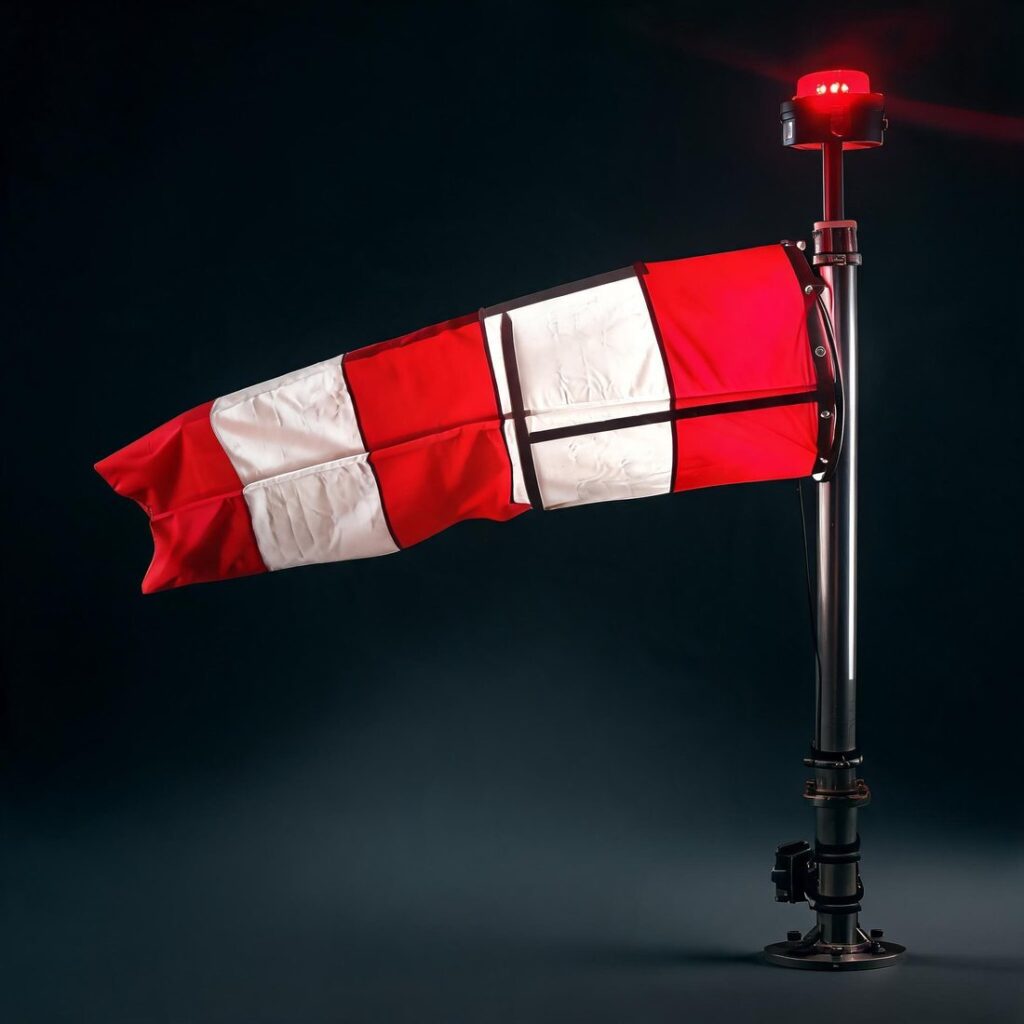
Wind direction is one of the most critical factors in safe helicopter operations. Pilots approaching a helipad — whether on a rooftop, offshore platform or onshore heliport — rely on wind indicators to judge their final approach angle, determine crosswind conditions and plan a safe touchdown. During the day, a standard fabric windsock is easy to read. After dark, it disappears.
That is precisely why the internally lighted windsock exists — and why ICAO and CAP 437 make it a requirement for any helipad operating during hours of darkness or reduced visibility.
What Is an Internally Lighted Windsock?
An internally lighted windsock is a wind direction indicator fitted with an internal light source that illuminates the fabric cone from within. Unlike an externally lighted windsock — where a separate floodlight shines onto the sock from outside — the internal light source provides even, consistent illumination across the entire length of the sock, making wind direction immediately readable from the air at any approach angle.
The light source is typically a high-efficiency LED unit running at 5700K (cool white), which closely replicates daylight and ensures the colour markings on the sock fabric remain clearly visible in all conditions.
ICAO and CAP 437 Requirements for Windsock Lighting
ICAO Annex 14 (Aerodromes) requires that wind direction indicators at helipads operating during the hours of darkness are illuminated so as to be clearly visible from the air. CAP 437 — the UK Civil Aviation Authority’s standard for offshore helideck operations — specifies the same requirement and extends it to apply during any period of reduced visibility.
Both standards also define performance requirements for the windsock itself: the cone must reach a minimum horizontal extension under a defined wind speed, must be visible at a specified distance, and must be positioned to reflect the actual wind conditions on the landing area — not affected by rotor downwash or building turbulence.
Safe Area vs. Hazardous Area: Why It Matters
Not all helipads are created equal. A rooftop helipad on a commercial building sits in a safe area — conventional electrical equipment applies. An offshore oil platform or petrochemical facility is classified as a potentially explosive atmosphere (ATEX Zone 1 or Zone 2). In these environments, any electrical equipment — including the light source inside a windsock — must be Ex-rated (explosion-proof) to prevent ignition.
Hardy Lighting’s internally lighted windsock is engineered to serve both applications: a standard configuration for safe areas and an Ex-rated obstruction light variant for hazardous area use. This dual capability means one product platform covers the full range of oil and gas, helideck, and onshore helipad installations.
Where Are Internally Lighted Windsocks Required?
- Offshore helidecks and FPSOs — mandatory under CAP 437 for all night and reduced-visibility operations
- Rooftop hospital helipads — critical for emergency medevac approaches after dark
- Onshore heliports and airfields — required by ICAO Annex 14 for any facility operating at night
- Oil, gas and petrochemical plants — Ex-rated units required in classified hazardous zones
- Military and defence facilities — where 24-hour operational readiness is essential
What to Look For When Specifying a Lighted Windsock
When specifying an internally lighted windsock for a project, consider the following:
Hazardous area classification. Confirm whether the installation location is a safe area or an ATEX zone before specifying. Fitting standard electrical equipment in a hazardous area is both non-compliant and dangerous.
Mast height and sock size. ICAO and CAP 437 specify minimum visibility distances, which influence the required sock diameter and mast height. Common sizes range from Ø30×120 cm to Ø45×250 cm. Mast height typically ranges from 1 to 6 metres.
Compliance certificates. Ensure the unit carries valid ICAO and CAP 437 compliance documentation, and that it is IP66 rated for outdoor and offshore use. Salt spray testing (minimum 240 hours) is essential for coastal and offshore installations.
Manufacturing origin. The source of manufacture matters for quality assurance and after-sales support. Products engineered in Europe, assembled in the UAE benefit from short supply chains to GCC projects and direct technical support.
Hardy Lighting’s Internally Lighted Windsock
Hardy Lighting’s internally lighted windsock is manufactured entirely in the UAE from stainless steel (SS316), making it corrosion-resistant, durable and compliant with the most demanding offshore environments. The unit features a 360-degree rotatable frame, DN65 flange mounting, and compatibility with all three standard sock sizes. It is ICAO and CAP 437 compliant, IP66 rated, and independently photometric-tested.
Whether you are fitting a rooftop helipad in Dubai, outfitting an FPSO in the Gulf of Oman, or commissioning an onshore heliport in the region, Hardy Lighting provides a certified, in-stock solution ready for immediate dispatch.
To specify Hardy Lighting’s internally lighted windsock for your project, contact us via WhatsApp or email for technical data and lead times.