
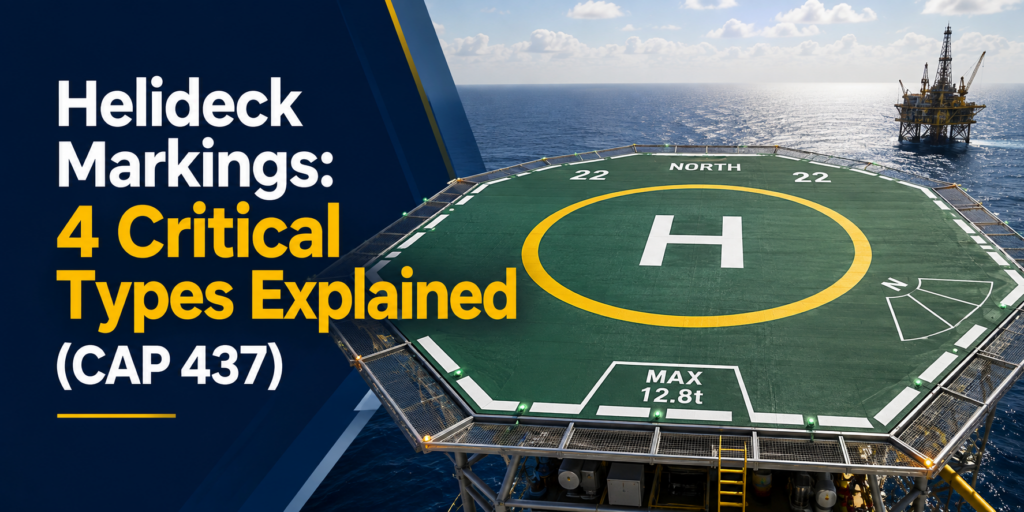
A helideck tells a pilot everything they need to know in the few seconds before touchdown — where to land, how big the deck is, and, critically, whether it’s even safe to land at all. Lighting gets most of the attention in helideck design conversations, but the painted and physical helideck markings underneath that lighting scheme are just as essential, and they’re standardised for a reason: a pilot approaching an unfamiliar platform, at night, in poor weather, needs to read the deck instantly and correctly.
This guide walks through the core helideck markings required under CAP 437 (the UK CAA standard for offshore helicopter landing areas, widely referenced internationally) — what each one looks like, what it tells a pilot, and where lighting and markings work together.
What Are Helideck Markings?
Helideck markings are the standardised painted, physical and (increasingly) illuminated features on a helideck’s surface that communicate landing area boundaries, deck identity, deck size and — when necessary — a warning that the deck is closed. They’re designed to be read at a glance from the air, which is why colour, shape and position are tightly specified rather than left to individual operator preference.
The Core Helideck Markings Explained
Touchdown/Positioning Marking (TDPM) Circle
The TDPM circle is the primary marking a pilot uses to position the helicopter for touchdown. It defines where the helicopter’s undercarriage should be positioned relative to the deck, accounting for the aircraft’s dimensions and the deck’s usable landing area. On many modern helidecks, especially since CAP 437’s 7th edition, the TDPM circle is not just painted — it’s a lit circle, illuminated so it remains clearly visible at night and in reduced visibility, alongside the deck’s perimeter lighting.
Heliport Identification “H” Marking
The “H” marking identifies the surface as a helideck and is typically positioned at the centre of the TDPM circle. Like the circle itself, current CAP 437 guidance calls for the H marking to be illuminated on helidecks operating at night, not just painted — giving pilots a clear, lit reference point for the deck’s centre from any approach angle.
Perimeter Marking
The perimeter marking defines the usable edge of the helideck — the boundary a pilot must stay within during approach, touchdown and ground operations. This is reinforced (and, at night, effectively replaced as the primary visual cue) by the helideck’s perimeter lighting — a ring of lights around the deck edge. We cover the lighting side of this in detail in our helideck perimeter lighting guide.
D-Value and Deck Size Markings
Helidecks are also marked or documented with a D-value marking — the maximum rotor diameter and overall length dimension the deck is certified to accept — so visiting pilots and operators can confirm their aircraft type is compatible with the deck before dispatch. This isn’t always a painted marking on the deck itself; it’s frequently published in the platform’s helideck operating manual and referenced in charts, but some operators do mark deck size/limit information directly on or near the deck as an additional visual cue.
The Prohibited Landing Marker: When a Helideck Is Closed
Not every marking on a helideck is permanent. The prohibited landing marker is a large, high-visibility cover — typically a heavy-duty fabric panel in a red-and-yellow diagonal cross pattern, sized to obscure the deck’s H marking and TDPM circle — that’s deployed over the landing area whenever the deck is unsafe or unavailable for landing.
Typical situations that call for a prohibited landing marker include:
- Planned maintenance or inspection work on or near the deck
- Emergency conditions affecting deck safety
- Equipment staging or hot work operations on the platform
- Any other period where the deck must be positively signalled as closed, not just assumed unavailable
Because it physically covers the primary landing markings, a prohibited landing marker leaves no ambiguity for an approaching pilot — which is exactly the point. Products in this category are typically built to be CAP 437 compliant and, in some regions, cross-compliant with equivalent local offshore helicopter landing standards, as detailed by suppliers such as Windsocks Australia’s HLS-PLM datasheet.
Lit vs Painted Markings: The CAP 437 7th Edition Shift
Earlier editions of CAP 437 treated the TDPM circle and H marking primarily as painted features, with lighting concentrated on the deck perimeter. The 7th edition of CAP 437 moved toward a fully lit helideck marking scheme — perimeter lights, a lit TDPM circle and a lit H marking together — reflecting how much offshore helicopter operation now happens at night or in marginal visibility. If you’re working from an older helideck lighting design or auditing an existing installation, it’s worth checking which edition of CAP 437 it was designed against, since the lit-marking requirement is one of the more significant changes in recent editions.
Markings and Lighting: How They Work Together
Markings and lighting aren’t separate systems on a well-designed helideck — they’re one visual language read together. The perimeter marking is reinforced by perimeter lights; the TDPM circle and H marking are reinforced by their own illumination; and the prohibited landing marker overrides the whole scheme when the deck is closed. For the regulatory framework tying all of this together, see our CAP 437 helideck lighting compliance guide.
Frequently Asked Questions
What is a TDPM circle on a helideck?
The Touchdown/Positioning Marking circle — the primary marking a pilot uses to position a helicopter for touchdown, often illuminated on modern helidecks so it stays visible at night.
Why does a helideck need a prohibited landing marker if it already has an H marking?
The H marking and TDPM circle tell a pilot where to land when the deck is open. The prohibited landing marker overrides that by physically covering those markings whenever the deck is closed — for maintenance, emergencies, hot work or any other unsafe condition — so there’s no ambiguity from the air.
Are helideck markings required to be lit, or is painting sufficient?
It depends on the applicable standard and edition, and whether the deck operates at night. Current CAP 437 guidance calls for a fully lit scheme — perimeter, TDPM circle and H marking — on helidecks used during darkness or reduced visibility.
What does D-value mean for a helideck?
It refers to the maximum helicopter size (based on rotor diameter and length) the deck is certified to accept — used by operators and pilots to confirm aircraft compatibility before dispatch.
Get Compliant Helideck Lighting and Markings
Whether you’re specifying a lit TDPM circle and H marking for a new build, upgrading an older helideck to the current CAP 437 lighting scheme, or sourcing a prohibited landing marker for deck-closure procedures, matching the equipment to the current standard is the detail worth getting right. Browse our Green Perimeter Light and full products page, or get in touch with your platform’s details.