Helicopter operations to offshore oil and gas platforms carry a level of risk that simply does not exist at land-based airports. There are no go-arounds to a safe alternative runway. The landing area is small, moving with the platform, surrounded by obstructions, and exposed to some of the most demanding environmental conditions on the planet. Night operations and reduced-visibility approaches are routine.
It is precisely this environment that CAP 437 was written for. If you operate, own or manage an offshore helideck — whether on a fixed platform, FPSO, semi-submersible, or any marine vessel — understanding CAP 437’s lighting requirements is not optional. It is a condition of safe operation.
What Is CAP 437?
CAP 437 is the Standards for Offshore Helicopter Landing Areas published by the United Kingdom Civil Aviation Authority (CAA). It defines the minimum standards for the design, construction, equipment and operation of offshore helidecks. Although it originates from the UK CAA, CAP 437 is recognised internationally as the authoritative standard for offshore helideck operations and is referenced by operators, insurance bodies and aviation regulators across the Middle East, North Sea, West Africa and Asia-Pacific.
For lighting specifically, CAP 437 aligns closely with ICAO Annex 14 (Heliports) but adds additional requirements relevant to the offshore environment — including higher environmental protection standards and specific requirements for obstacle marking.
Who Does CAP 437 Apply To?
CAP 437 applies to any offshore installation where helicopter operations take place — including night operations or operations in reduced visibility. This covers fixed production platforms, floating production storage and offloading vessels (FPSOs), accommodation vessels, crane vessels, pipe-lay barges and any other marine installation with a helicopter landing area.
If helicopter operations are conducted to your installation at any time outside daylight hours, CAP 437 lighting requirements are triggered in full.
Lighting Requirements Under CAP 437
CAP 437 defines requirements across four areas of helideck lighting:
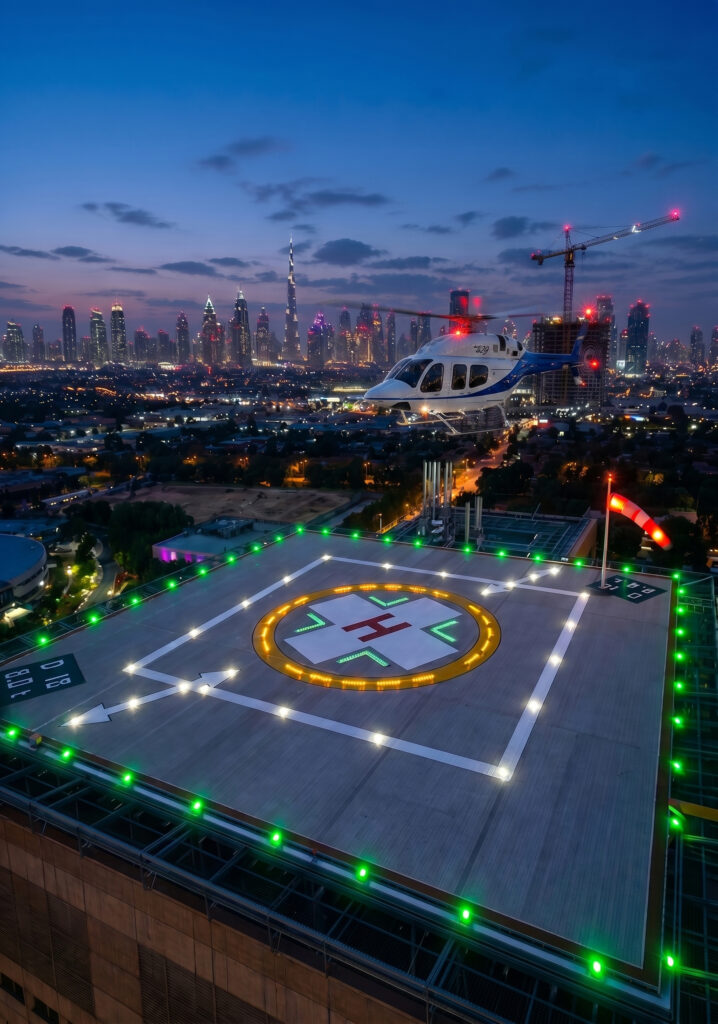
Perimeter lighting. The FATO/TLOF boundary must be marked with green perimeter lights. The standard specifies a minimum intensity of 32 cd, with lights positioned at intervals not exceeding 3 metres around the perimeter. The lights must be capable of operating in all conditions, including pitch and roll of the platform, and must maintain their performance over years of exposure to salt spray and marine atmosphere.
Floodlighting. The helideck must be provided with floodlighting sufficient to allow the pilot to assess the landing area and the deck crew to operate safely during approach and landing. Floodlights must be positioned to avoid glare to the approaching pilot.
Obstacle lighting. Any structure on or adjacent to the helideck that constitutes an obstacle must be marked with red obstruction lights. This includes crane jibs, exhaust stacks, derricks and antenna masts.
Wind direction indicator. A lighted windsock must be provided and must be visible from the pilot’s approach path. The windsock must be illuminated — either internally or externally — to remain readable throughout all lighting conditions on the deck.
The Role of Perimeter Lighting on an Offshore Helideck
The green perimeter light ring is the primary visual reference the pilot uses in the final stages of approach. In conditions of reduced visibility, rain, sea spray or darkness, the perimeter ring is often the first clear indication of the helideck’s position, orientation and size. Without it — or with degraded lights — the pilot’s decision-making is compromised precisely when it matters most.
The critical requirement is not simply that lights are installed, but that they remain operational in the offshore environment. A perimeter light that fails under salt spray or vibration after six months is a compliance gap and an operational hazard.
Windsock Requirements Under CAP 437
CAP 437 requires a lighted wind direction indicator to be provided at every offshore helideck operating at night or in reduced visibility. The windsock must be sited to reflect the actual wind conditions across the landing area — not affected by turbulence from the superstructure or rotor downwash — and must be visible from the pilot’s normal approach direction.
The light source (internal or external) must provide sufficient illumination for the wind direction and speed (indicated by the cone’s angle of extension) to be clearly readable from the cockpit.
IP66 and Salt Spray Testing: Why the Marine Environment Demands More
Standard outdoor luminaires are not adequate for offshore use. The combination of constant salt spray, high humidity, temperature cycling, UV exposure and physical vibration degrades both the optical performance and the structural integrity of inadequately specified equipment.
CAP 437-compliant fixtures should carry a minimum IP66 rating and demonstrate salt spray resistance through formal testing to ASTM B117 or ISO 9227 for a minimum of 240 hours. Products without formal test certification — regardless of claims made in brochures — should not be specified for offshore helideck use.
Hardy Lighting and CAP 437
Hardy Lighting’s full product range is designed, engineered and tested to meet CAP 437 requirements. The green perimeter light provides 32 cd green illumination, is IP66 rated and 240-hour salt spray tested. The internally lighted windsock is independently photometric-tested and available in both safe-area and Ex-rated configurations. All products carry formal compliance documentation and are available for immediate dispatch to offshore projects in the region and internationally. Contact Hardy Lighting to request technical data sheets, compliance certificates, or a quotation for your helideck lighting project.