
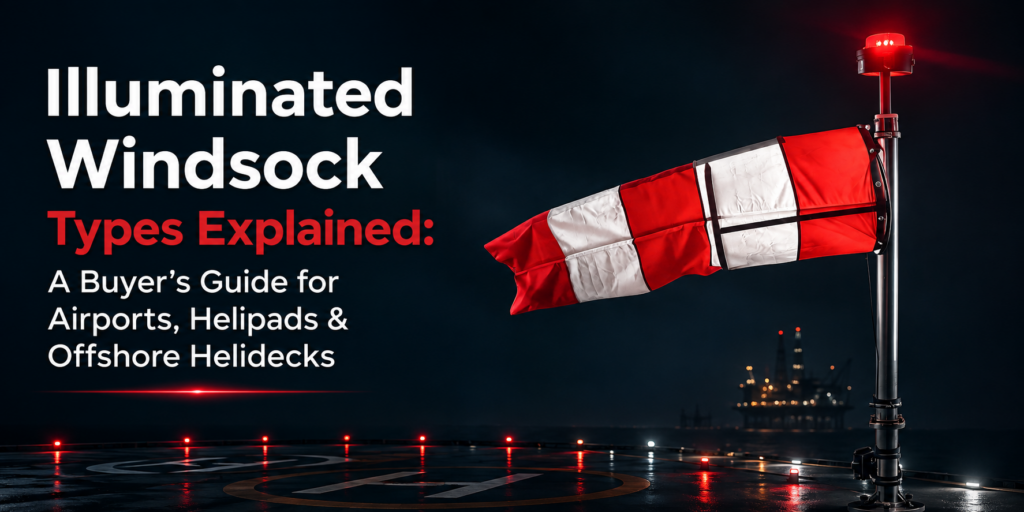
Wind direction is one of the first things a pilot checks before every approach, and it doesn’t stop mattering when the sun goes down. During daylight, a plain fabric windsock does the job on its own. At night, in fog, or in the reduced visibility common on offshore platforms, that same windsock is invisible unless it’s lit — which is exactly why an illuminated windsock is a mandatory piece of equipment at almost every helipad, heliport, offshore helideck and airfield that operates outside daylight hours.
“Illuminated windsock” isn’t one single product, though. It’s a category that covers several genuinely different designs — internally lit versus externally lit, single-light versus double-light, standard-duty versus explosion-proof — and the right choice depends heavily on where the unit will be installed and which standard it needs to satisfy. This guide breaks down each type, explains how they differ, and points you to the regulatory requirements (ICAO, CAP 437, FAA) that govern them.
What Is an Illuminated Windsock?
An illuminated windsock — also called a lighted windsock, LED windsock, or lighted wind cone — is a wind direction indicator (WDI) that stays visible after dark. Instead of relying on ambient light, the unit either lights itself from the inside or is lit by an external fixture, so pilots can read wind direction and, to a lesser extent, estimate wind speed from the sock’s angle during a night approach.
Every illuminated windsock is built around the same core components: a fabric cone (usually orange, or orange-and-white for aviation use, though colour requirements vary by application), a frame or mount that lets the sock rotate freely with the wind, and a lighting system. It’s that lighting system — how the sock is lit, and how the fixture is protected — where the real differences between windsock lighting types show up.
Main Types of Illuminated Windsocks
Internally Lit Windsocks
An internally lit windsock has an LED light source mounted inside the frame at the base (or sometimes distributed along the length) of the cone, so the fabric itself glows from within. This is the design most commonly specified for helipads, heliports and offshore helidecks, because it delivers even illumination across the whole sock regardless of the angle a pilot is viewing it from — there’s no dark side and no shadowing from an external fixture.
We’ve covered this design in detail in our internally lighted windsock guide, including how it compares against ICAO and CAP 437 lighting requirements, and it’s available as a standard product: Internally Lighted Windsock.
Externally Lit Windsocks
An externally lit windsock uses one or more floodlights, mounted separately from the cone, aimed up at the fabric from below or the side. This approach is more common at general aviation airports and some military airfields, particularly where an internally lit assembly isn’t practical or where an existing floodlight already covers the wind cone location.
The trade-off is illumination evenness: external lighting can leave one side of the sock brighter than the other depending on wind direction, and the fixture itself needs its own separate maintenance and aiming checks. The FAA’s specification for wind cone lighting (AC 150/5345-27) formally recognises this as a distinct lighting style from internal illumination — more on that below.
Single-Light vs. Double-Light Systems
Within both internally and externally lit designs, you’ll also see single-light and double-light windsock systems:
- Single-light systems use one light source (typically at the base of an internally lit cone) and are the standard specification for most helipads and general aviation applications.
- Double-light systems add a second, redundant light source — either as a backup if the primary fails, or to improve visibility at larger installations, taller masts, or sites where regulatory or client specifications call for redundancy (common on some offshore and critical-infrastructure sites).
If your project specification calls out redundant lighting, or the windsock is on a mast that’s difficult to access for emergency repairs, a double-light system is worth the modest additional cost.
Hazardous-Area (Explosion-Proof) Windsocks
On oil and gas platforms, refineries, LNG facilities and other sites classified as hazardous locations, a standard illuminated windsock isn’t suitable — the electrical components need to be rated for use around flammable gases and vapours. Hazardous-location windsock systems use explosion-proof (ATEX/IECEx-rated) enclosures and certified LED light sources so the unit can be installed in Zone 1/Zone 2 classified areas without becoming an ignition risk.
This is a specification detail worth confirming early: an offshore helideck on a production platform will almost always require a hazardous-area-rated illuminated windsock, not a standard commercial unit.
Non-Lighted / Unlit Windsocks — When They’re Still Used
Not every site needs a lighted windsock. Daylight-only helipads, some private airstrips, and secondary or backup wind indicators are often specified as non-lighted (unlit) systems, which are simpler, cheaper and require no electrical connection. We supply these as well — see the Unlighted Windsock / Safe Area WDI for daylight-only or secondary-indicator applications. The key is knowing your operating hours: if the site ever operates after dark or in reduced visibility, an unlit windsock will not meet ICAO or CAP 437 requirements.
LED vs. Traditional Windsock Lighting
Nearly all illuminated windsocks specified today use LED light sources rather than older incandescent or halogen fixtures, for a few practical reasons:
- Colour accuracy — high-quality LEDs run at a cool white colour temperature that closely replicates daylight, so the sock’s colour markings stay legible at night.
- Lower power draw — important for offshore and remote installations that may run on limited generator or solar capacity.
- Longer service life — fewer lamp changes on masts and structures that can be difficult and costly to access.
- Better cold-start and vibration performance — relevant for offshore platforms and exposed masts subject to constant wind loading.
If you’re comparing an “LED windsock” against an older fixture during a retrofit, the lighting technology is usually the biggest single factor in long-term maintenance cost.
Standards That Govern Windsock Lighting
Windsock lighting isn’t a matter of preference once a site is classified for night or low-visibility operations — it’s governed by aviation standards, and the specific standard depends on the type of site and its regulator.
- ICAO Annex 14 (Aerodromes / Heliports) sets the baseline international requirement: a wind direction indicator must be illuminated when the aerodrome or heliport is used during the hours of darkness, so it remains clearly visible from the air.
- CAP 437 (UK CAA — Standards for Offshore Helicopter Landing Areas) applies specifically to offshore helidecks and sets out the wind direction indicator requirements for those installations, including positioning the unit where it isn’t disturbed by turbulence from the platform structure itself. We go through this in more depth in our CAP 437 helideck lighting compliance guide.
- FAA AC 150/5345-27 (Specification for Wind Cone Assemblies) is the US standard and is the most specific about lighting method. It defines two lighting styles — Style I‑A, an externally lit cone illuminated by floodlighting, and Style I‑B, an internally lit cone — along with the supporting structure types, L‑806 (a low-mass, frangible mount) and L‑807 (a rigid, hinged mount). If you’re specifying to FAA standards, confirm both the lighting style and the structure type your project calls for.
Because editions of these standards are periodically revised, always check the current published version — through your national aviation authority or the FAA’s advisory circular library — before finalising a specification.
Choosing the Right Illuminated Windsock for Your Site
| Site type | Typically specified |
|---|---|
| Rooftop or ground-level helipad | Internally lit, single-light |
| Offshore oil & gas helideck | Internally lit, hazardous-area rated, often double-light for redundancy |
| Hospital / medevac helipad | Internally lit, single-light, ICAO/CAP 437 or FAA-compliant |
| General aviation airfield | Internally or externally lit, per FAA AC 150/5345-27 Style I-A or I-B |
| Military airfield | Internally or externally lit, per applicable defence spec |
| Daylight-only site or backup indicator | Non-lighted (unlit) |
If you’re not sure which category your project falls into, the safest approach is to confirm the applicable standard first (ICAO, CAP 437, FAA, or a client/military specification) and then match the windsock type to it — rather than choosing a product and hoping it fits the requirement.
Installation & Maintenance Tips
- Mount the windsock where airflow is undisturbed by nearby buildings, cranes, flare stacks or platform structures — turbulence near the mount gives pilots false wind readings.
- Check LED driver housings and cable glands regularly, especially on offshore or coastal sites where salt-air corrosion is a real risk.
- Inspect the fabric cone for fading, tearing or stiffening; a damaged sock can misrepresent wind speed even if the lighting is functioning normally.
- On hazardous-area units, never substitute non-rated components during repairs — this invalidates the explosion-proof certification.
- Where a double-light system is installed, test both circuits independently, not just the combined output.
Frequently Asked Questions
What is the difference between an internally lit and externally lit windsock?
An internally lit windsock has its light source built into the frame so the fabric glows evenly from within. An externally lit windsock is illuminated by a separate floodlight aimed at the cone from outside, which can leave uneven lighting depending on viewing angle.
Do all helipads need an illuminated windsock?
Only if the site operates during darkness or reduced visibility. A helipad used exclusively in daylight can use a non-lighted windsock, but any site with night or low-visibility operations needs a lighted unit to meet ICAO, CAP 437 or FAA requirements.
Can a windsock be used in a hazardous or explosion-proof location?
Yes, but it needs to be a purpose-built hazardous-area (ATEX/IECEx-rated) illuminated windsock, not a standard commercial unit. This is standard practice on oil and gas platforms and other classified sites.
What’s the benefit of a double-light windsock system?
Redundancy. If one light source fails, the second keeps the windsock visible until maintenance can access it — particularly valuable on offshore platforms and tall masts that are difficult to reach quickly.
What colour light should an illuminated windsock use?
Most specifications call for a cool white LED (daylight-matching) light source, since it renders the sock’s colour markings most accurately at night. Check your specific standard for any colour temperature requirements.
Get the Right Windsock Lighting for Your Site
Whether you need an internally lit windsock for a rooftop helipad, a hazardous-area-rated system for an offshore helideck, or a non-lighted unit for a daylight-only site, matching the product to the applicable standard is the part worth getting right before you order. Browse our full range on the products page, or get in touch with your site details and we’ll help you specify the correct type.