
Rooftop helipads are a growing feature of commercial towers, hospitals, luxury hotels and government buildings across the UAE and the wider region. Emergency medevac operations, VIP transport and air ambulance services depend on them — and increasingly, so do the buildings’ occupancy permits and insurance policies.
What many building owners and facilities managers do not realise is that a helipad’s lighting configuration is not discretionary. It is defined by international standards, inspected by aviation authorities, and fundamental to whether the helipad can legally operate after dark. Getting it wrong does not just create a compliance gap — it means the pad cannot be used when it is needed most.
Why Lighting Is the Most Critical Safety Element of a Helipad
A helipad that is visible during the day can become invisible at night without proper lighting. Pilots approaching a rooftop helipad rely entirely on the lighting system to identify the landing zone, assess the wind conditions, judge their approach angle and plan a safe touchdown. Every element of the lighting system serves a specific safety function. None of it is decorative.
What ICAO Requires for a Rooftop Helipad
ICAO Annex 14 (Volume II — Heliports) defines the minimum lighting requirements for elevated helipads. The standard applies globally and is adopted by the UAE General Civil Aviation Authority (GCAA) and equivalent bodies across the region. Key requirements include: a defined and lit landing area boundary, a wind direction indicator that remains readable at night, and obstacle marking for any structures in the vicinity of the approach path.
The Four Essential Lighting Components
Green perimeter lights. The boundary of the FATO (Final Approach and Take-Off area) must be marked with green lights at intervals of no more than 3 metres. Minimum intensity is 32 cd. These form the ring that pilots identify during their approach — the primary visual reference for landing zone position, orientation and size.
White FATO and approach lights. For helipads with formal instrument approach procedures, or where enhanced pilot guidance is required, white obstruction lights are used to define the approach path and the FATO/TLOF area. Hardy Lighting offers two variants: a 100 cd FATO light and a 350 cd approach light for greater range guidance.
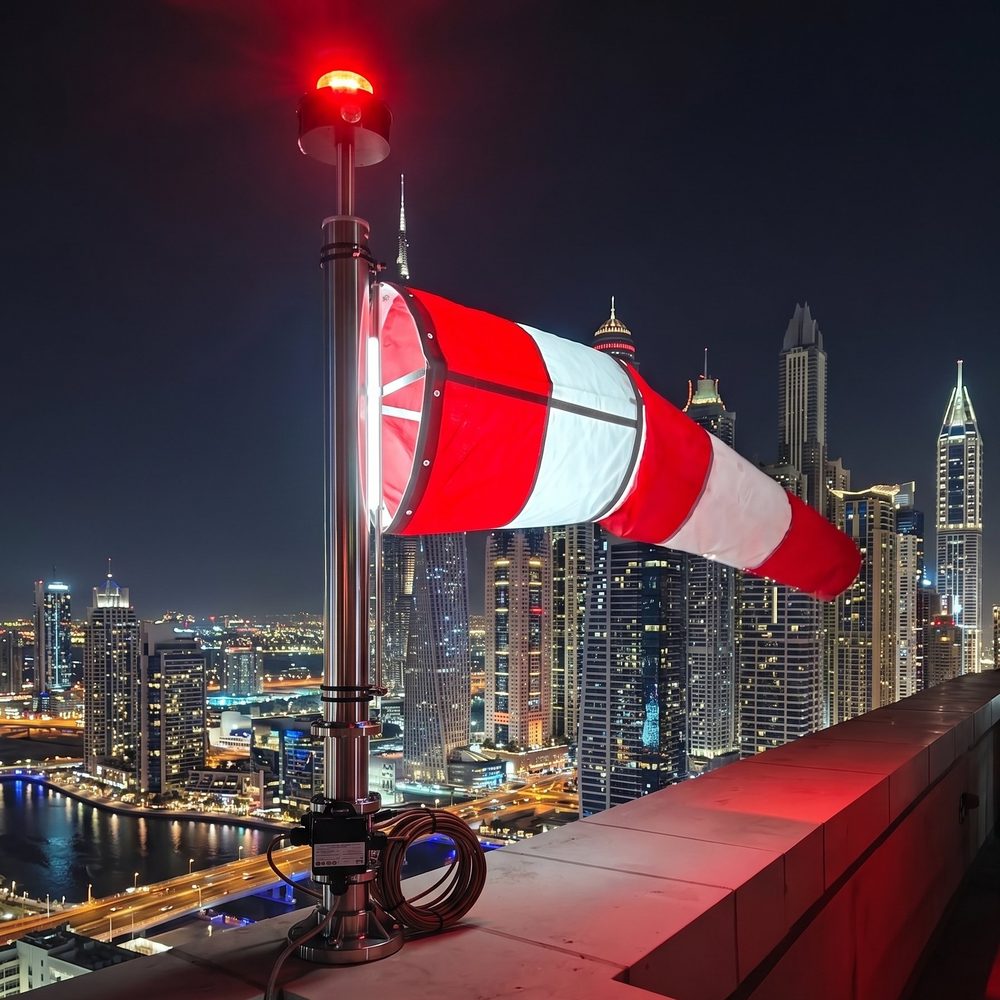
Lighted windsock. Every helipad operating at night requires an internally lighted windsock that gives the pilot accurate, readable wind direction and speed indication on approach and on the pad. The windsock must be positioned clear of rotor downwash and turbulence caused by the building structure.
Obstruction marking. Any structure near the helipad that could be a hazard to the approach path — antenna masts, air-conditioning plant, cooling towers, parapet walls — must be marked with red obstruction lights. The intensity required depends on the structure’s proximity to the approach path.
Common Mistakes Made During Helipad Lighting Installations
The most frequent compliance failures seen during helipad audits are: perimeter lights spaced too far apart, windsocks positioned in a turbulence pocket, floodlights angled to create glare on the approach path, and obstruction lights omitted from structures that clearly constitute hazards. Many of these mistakes arise not from negligence but from specifying products and layouts without reference to ICAO and local GCAA guidance.
Engaging a certified lighting supplier early in the project — ideally at the design stage — prevents all of these issues and simplifies the regulatory approval process.
Maintaining Compliance After Installation
A rooftop helipad is not a set-and-forget installation. Lights degrade, bulbs fail, windsock fabrics deteriorate, and mast mechanisms can seize. ICAO and the GCAA require that helipads are maintained in a state of continuous compliance. A single failed perimeter light or an unreadable windsock can result in the helipad being declared unserviceable — meaning no night operations until it is rectified.
Specifying high-quality, IP66-rated fixtures with independently tested photometric performance significantly reduces maintenance frequency and the risk of unexpected failures.
Hardy Lighting for Rooftop Helipads
Hardy Lighting supplies the complete range of certified lighting required for a rooftop helipad: green perimeter lights, white FATO and approach lights, and internally lighted windsocks — all ICAO and CAP 437 compliant, IP66 rated, and backed by a 2-year warranty. Products are engineered in Europe, assembled in the UAE, in stock, and available for immediate dispatch.
Contact Hardy Lighting via WhatsApp or email for a product recommendation, technical data sheet, or quotation based on your helipad’s dimensions and operating requirements.